# Install packages
if (!requireNamespace("data.table", quietly = TRUE)) {
  install.packages("data.table")
}
if (!requireNamespace("jsonlite", quietly = TRUE)) {
  install.packages("jsonlite")
}
if (!requireNamespace("circlize", quietly = TRUE)) {
  install.packages("circlize")
}
if (!requireNamespace("ggplotify", quietly = TRUE)) {
  install.packages("ggplotify")
}

# Load packages
library(data.table)
library(jsonlite)
library(circlize)
library(ggplotify)Chord Plot
Note
Hiplot website
This page is the tutorial for source code version of the Hiplot Chord Plot plugin. You can also use the Hiplot website to achieve no code ploting. For more information please see the following link:
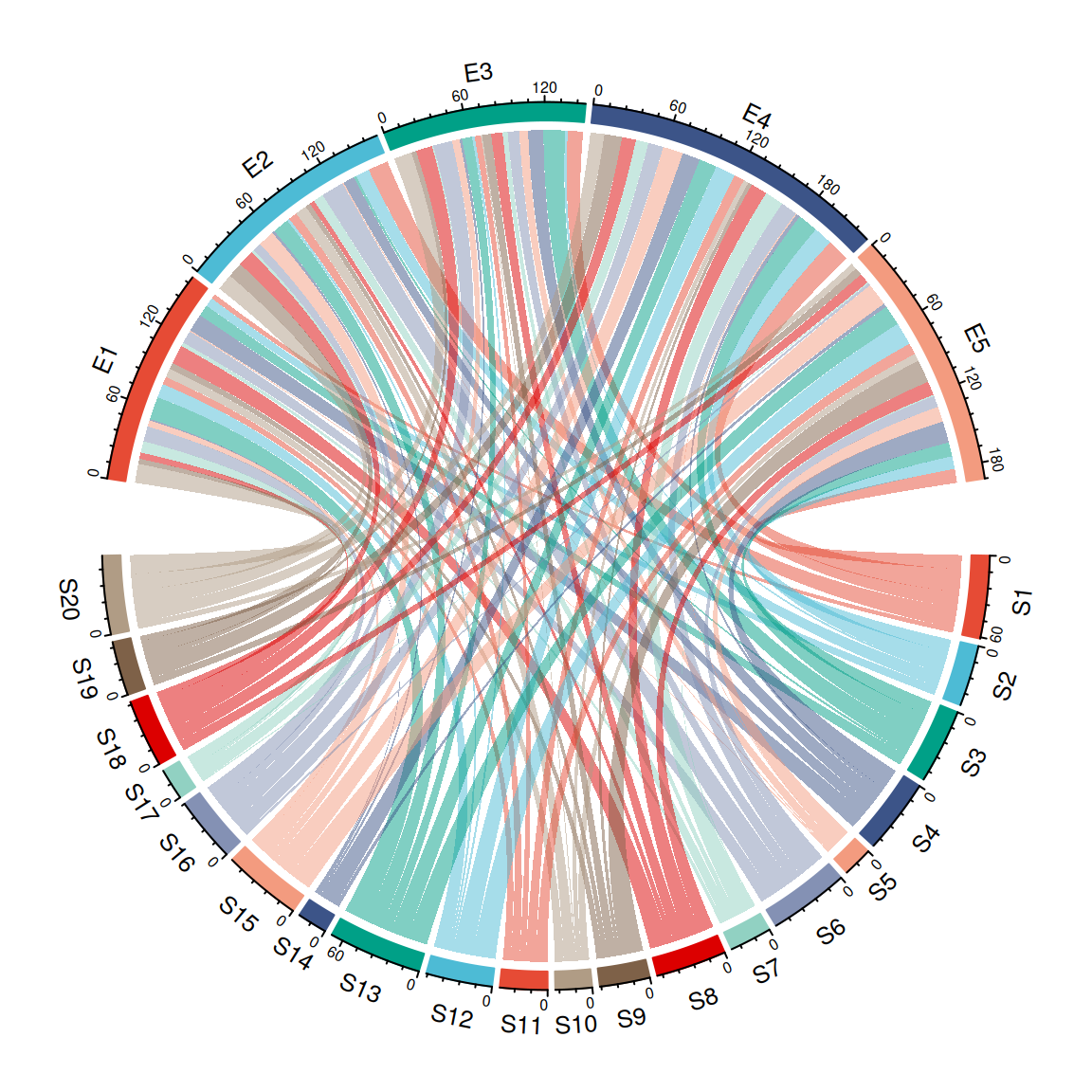
The complex interaction is visualized in the form of chord graph.
Setup
System Requirements: Cross-platform (Linux/MacOS/Windows)
Programming language: R
Dependent packages:
data.table;jsonlite;circlize;ggplotify
sessioninfo::session_info("attached")─ Session info ───────────────────────────────────────────────────────────────
setting value
version R version 4.6.0 (2026-04-24)
os Ubuntu 24.04.4 LTS
system x86_64, linux-gnu
ui X11
language (EN)
collate C.UTF-8
ctype C.UTF-8
tz UTC
date 2026-05-09
pandoc 3.1.3 @ /usr/bin/ (via rmarkdown)
quarto 1.9.37 @ /usr/local/bin/quarto
─ Packages ───────────────────────────────────────────────────────────────────
package * version date (UTC) lib source
circlize * 0.4.18 2026-04-04 [1] RSPM
data.table * 1.18.4 2026-05-06 [1] RSPM
ggplotify * 0.1.3 2025-09-20 [1] RSPM
jsonlite * 2.0.0 2025-03-27 [1] RSPM
[1] /home/runner/work/_temp/Library
[2] /opt/R/4.6.0/lib/R/site-library
[3] /opt/R/4.6.0/lib/R/library
* ── Packages attached to the search path.
──────────────────────────────────────────────────────────────────────────────Data Preparation
Data frame or matrix of interaction of genes with pathways or gene ontologys.
# Load data
data <- data.table::fread(jsonlite::read_json("https://hiplot.cn/ui/basic/chord/data.json")$exampleData$textarea[[1]])
data <- as.data.frame(data)

# convert data structure
row.names(data) <- data[, 1]
data <- data[, -1]
data <- as.matrix(data)

# View data
head(data)
E1 E2 E3 E4 E5
S1 4 16 12 18 11
S2 7 11 2 15 10
S3 9 2 17 16 11
S4 14 9 12 3 17
S5 1 1 7 1 12
S6 10 18 9 13 9Visualization
# Chord Plot
Palette <- c("#E64B35FF","#4DBBD5FF","#00A087FF","#3C5488FF","#F39B7FFF",
             "#8491B4FF","#91D1C2FF","#DC0000FF","#7E6148FF","#B09C85FF")
grid.col <- c(Palette, Palette, Palette[1:5])
p <- as.ggplot(function() {
  chordDiagram(
    data, grid.col = grid.col, grid.border = NULL, transparency = 0.5,
    row.col = NULL, column.col = NULL,  order = NULL,
    directional = 0, # 1, -1, 0, 2
    direction.type = "diffHeight", # diffHeight and arrows
    diffHeight = convert_height(2, "mm"), reduce = 1e-5, xmax = NULL,
    self.link = 2, symmetric = FALSE, keep.diagonal = FALSE,
    preAllocateTracks = NULL,
    annotationTrack = c("name", "grid", "axis"),
    annotationTrackHeight = convert_height(c(3, 3), "mm"),
    link.border = NA, link.lwd = par("lwd"), link.lty = par("lty"),
    link.sort = FALSE, link.decreasing = TRUE, link.largest.ontop = FALSE,
    link.visible = T, link.rank = NULL, link.overlap = FALSE,
    scale = F, group = NULL, big.gap = 10, small.gap = 1
    )
  })

p